Subscribe News Feed Subscribe Comments

Risk Aversion Edges Up

Over the last few weeks, the stock market rally has fizzled and commodities prices have cooled off. It’s not clear what triggered this sudden surge in introspection (I would call it reasonableness). Regardless, the markets are now wondering out loud whether the optimism of the second quarter wasn’t a bit naive.

After all, there still isn’t any evidence that global economy has turned a corner. Virtually all of the economic indicators that matter are still trending downwards. In addition, the apparent stabilization in housing prices could prove temporary, as banks move away from loan modifications and back towards foreclosure. Rumors that the Obama administration are considering a second stimulus plan are already circulating

With second quarter corporate earnings season set to kick off next week, investors are once again bracing for the worst: “Given the strong performance of stocks relative to March lows, a reality check from earnings could be detrimental to risk appetite.” Adds another analyst, “It’s renewed risk aversion, triggered by mounting doubts about a near-term economic recovery that’s evident in the sell-off on Wall Street and the subsequent decline in risk assets in general.”

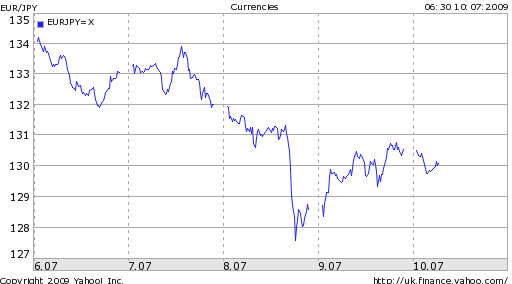
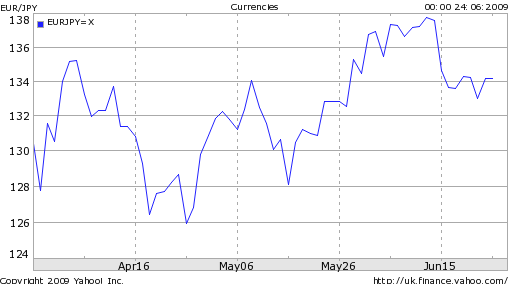
This pickup in risk aversion is also manifesting itself in forex markets, via the upturns in both the US Dollar and Japanese Yen: “The prospect of a slow and bumpy recovery remained the overriding driver of market sentiment and the dollar was soon reasserting itself as the currency of choice - apart from the yen.” Ironically, negative economic data that applies directly to the US is benefiting the Dollar, which goes a long way towards explaining the current market orientation. Currency traders have yet to turn towards comparative growth differentials (despite the predictions of some analysts) and remain firmly focused on risk. Meanwhile, “The yen rally has extended, driven by the liquidation of long-risk asset positions.” In other words, the carry trade has come under pressure as investors move back into low-risk government bonds.

euro-yenThe “uncertainty” narrative will likely continue to drive the markets for the near-term, as neither the optimists nor the pessimists have the data to support their respective positions. In all likelihood, the markets will trend sideways and safe haven currencies will see a slight inflow, until there is confirmation that the economy is firmly on the path to recovery.

Inflation Update: US Prices Creep up in May

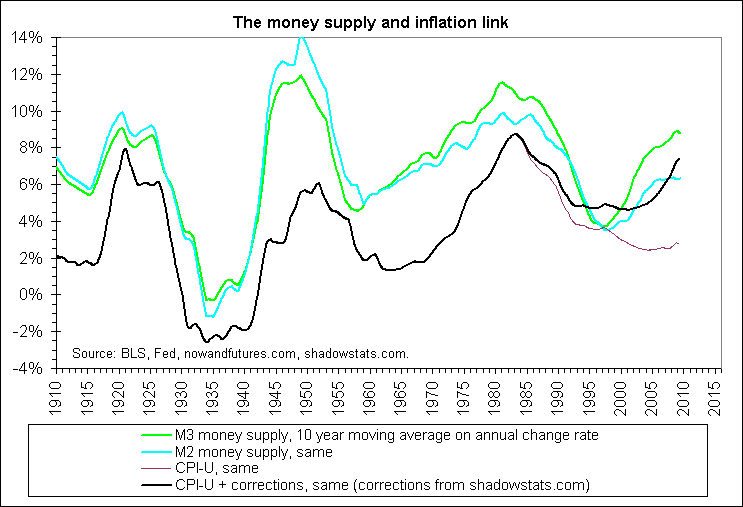
The debate over US inflation continues to be waged- in academic circles, among economists, and in the financial markets. There is no still no clear consensus as to the likelihood that the inflation will flare up at some point, as a result of the Fed’s easy monetary policy and the government’s record budget deficits. While the unprecedented nature of this crisis means that such a debate is still a matter of theory, that hasn’t stopped both sides from weighing in, often vehemently.

Admittedly, the risk of inflation in the short-term is still low: “With so much of the world ensnared by the economic downturn, demand for goods and services is weak, which tends to push down prices. Amid high unemployment, workers are in no position to demand wage increases.” Still, the Consumer Price Index (CPI) is already creeping up. The Fed’s “core” measure, which excludes food and energy prices, rose 1.8% from a year ago. If commodity prices continue to rise, the total CPI could soon become positive. (It currently stands at -1.3%).

Among academics and economists, the discussion is being framed relative to the Fed; specifically, can it - and more importantly, will it - move to unwind its quantitative easing program when the time comes? “If it acts prematurely to reduce the money supply, the Fed could stifle the recovery. If it waits too long, it could contribute to a jump in inflation. Its timing is going to have to be perfect,” says a former Fed economist.

This question remains divisive, as evidenced by the ongoing feud between the chief economist at Morgan Stanley and his counterpart over at Goldman Sachs. MS is concerned that the Fed will leave rates too long. According to one of his supporters, “The Fed absolutely has the tools and know-how, but the question is, will they have the guts to use them? I don’t think there is a snowball’s chance in hell they will be willing to tighten to slow inflation down.” Counters the GS camp: ““The Fed will be able to contain inflation pressures through a combination of raising interest rates and unwinding its balance sheets.”

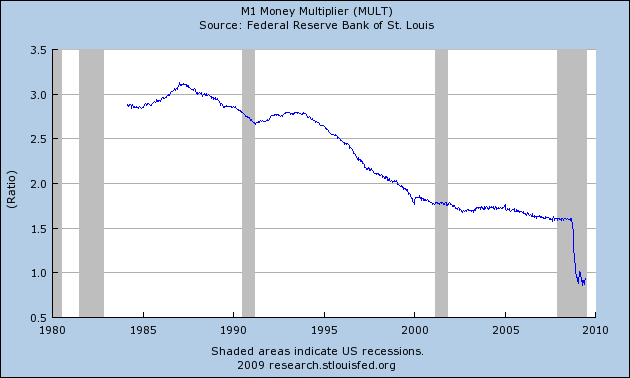
All of this talk seems premature when you consider that the money supply is barely growing, despite the Fed’s QE program: “M2, a gauge that includes savings and checking accounts, is 4.7 times the base cash supply, down from 9.3 times a year ago.”

m1-money-multiplier

“Of the $2.1 trillion that the Fed is injecting into the financial system, more than half, or 51 cents per dollar, is being posted back at the central bank by financial institutions in the form of excess reserves, a record high.” In other words, most of the Fed’s cash is not actually finding its way to consumers.

us-money-supply-and-inflation-link
Financial markets are equally ambivalent, although erring on the side of caution. Treasury yields on the long end of the curve have risen over the last few months, though this can be attributable to several causes. More specifically, “The spread been nominal 10-year Treasury yields and comparable-maturity TIPS yields has increased from approximately 0.25% at the start of the year to 1.65% currently, reflecting a 1.4% increase in expected CPI inflation over the next decade.” Based on this, it’s clear that while investors don’t share the doomsday pessimism of inflation hawks, they are nonetheless growing increasingly concerned.

Interview with Sean Hyman: “Trade with the trend”

As part of our ongoing series, printed below is an interview with Sean Hyman, of World Currency Watch. [Blog found here]. Sean has collected over 15 years of experience as a stockbroker, manager, and trader, working for enterprises as varied as a technical analysis “call in” line for their million dollar+ clients and active traders, Charles Schwab, and FXCM. Over this period, he has refined his trading approach through the use of fundamental/technical analysis and intermarket analysis, and now takes a very “macro” approach.

Read the rest of this entry »

Forex Reserve Growth Could Slow

Most of the recent discussion surrounding foreign exchange reserves has focused on the allocation of those reserves; specifically, whether or not these reserves will be invested in Dollar-denominated assets to the same extent as before. But what if this discussion fails to see the forest through the trees? In other words, this issue is built on the implicit premise that Central Banks will continue to build their forex reserves, and hence they need a place to invest them. With this post, I will examine whether this is indeed the case.

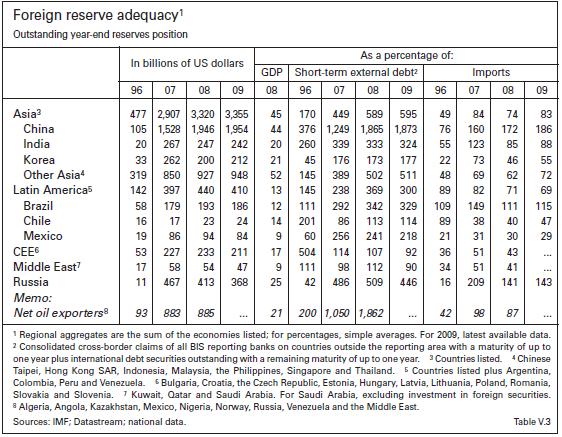
Since the start of the credit crisis, forex reserve growth has slowed as Central Banks (mainly in emerging markets) began to deploy some of their cash: “In the first quarter of 2009, foreign reserves were at 80% of their June 2008 levels in Korea and India, around 75% in Poland and 65% in Russia.” Most of the spending was used for direct intervention in currency markets and to finance capital outflows, as risk-averse investors moved funds out of emerging markets. Russia, alone, spent nearly $200 Billion trying to prevent a complete collapse in confidence in the Ruble.

Thanks to their prudence following the 1997 Southeast Asian economic crisis, however, reserves are still more than adequate based on most measures: “A well known rule of thumb (the so-called Guidotti-Greenspan rule) is that foreign reserves should cover 100% of external debt coming due within one year. In 2008, almost all EMEs far exceeded this threshold – coverage was more than 400% in Asia and Russia and around 300% in Latin America. Another rule of thumb, that foreign reserves should cover three to six months of imports (ie 25–50% of annual imports) was also typically exceeded at the end of 2008.” Even despite the recent declines, coverage remains strong enough to meet financing requirements for the immediate future. China, whose cache of forex is by far the world’s largest, boasts a coverage ratio of nearly 2,000%!

foreign-reserve-adequacyGiven such robustness, it’s clear that the impetus to continue accumulating reserves has eroded slightly. Central Banks have also come to realize how vulnerable they are to credit and currency risk, vis-a-vis the allocation of their reserves, which means that the best alternative going forward is probably to start investing in commodities and/or domestic economic initiatives. China has already begun to move in this direction.

There are several alternatives that are less risky/expensive than directly holding foreign exchange reserves. “First, in October 2008 four EME central banks each entered into a $30 billion reciprocal currency arrangement with the US Federal Reserve. Second, a $120 billion multilateral facility, drawing on international reserves, was recently established in East Asia…Third, recent G20 initiatives have called for large increases in resources for international financial institutions…[such as the] IMF’s recently created Flexible Credit Line.” Such programs provide countries in crisis with the cash to draw from without forcing them to build up reserves in advance.

To be fair, not all Central Banks are prepared to break from the current system. “In spite of significant interventions in the fourth quarter of 2008, many EMEs still had larger foreign reserves at the end of 2008 than they did in 2007.” Reports are coming in that Indian and Korean reserves, for example, have reached their highest levels since the collapse of Lehman Brothers last fall. This is sounding alarm bells for economic officials: “There is a hope the lesson taken away from the current experience is not that these countries need even larger foreign exchange reserves. These things are not terribly efficient. Our concern is that these things are going to be built up even further as a consequence.”

Will the Euro Survive the Credit Crisis?

The Euro has always had a marginal group of naysayers; there were always those who insisted that a common currency didn’t make sense for a region as diverse as the EU. As a result of the credit crisis, a bevy of critics have come out of the woodwork and declared that the Euro will not survive its first official crisis. Are they right?

According to a Special Report on the Euro Area published in the Economist (which inspired this post), the Euro has been a modest success by most measures. “The ECB has fulfilled its remit to maintain the purchasing power of the euro. Since the currency’s creation the average inflation rate in the euro area has been just over 2%. Fears that the euro would be a “soft” currency have proved unfounded. It is unquestioningly accepted at home and widely used beyond the euro area’s borders.” While the Euro hasn’t facilitated meaningful gains in productivity or GDP, it has unquestionably engendered greater stability.

euro-zone-members1

Ironically, the countries that are now complaining the loudest about the Euro are mainly those that benefited the most from its membership. The economy of Spain, for example, “grew at an average annual rate of 3.9% between 1999 and 2007, almost twice the euro-zone average and much faster than in any of the currency area’s other big countries…Unemployment fell from close to 20% in the mid-1990s to just 7.9% in 2007.”

Unfortunately, the economic boom also corresponded with a rise in prices and unit wage costs, both of which are now proving to be particularly painful in the context of recession. Aided by a strong currency, its current account deficit has risen to 10% of GDP. Meanwhile, the same problems are affecting Portugal, Ireland, Italy, and Greece. As the report explains, “The main hazard for investors in high-inflation countries—that a steady loss of domestic purchasing power will drag the currency down—is eliminated in a fixed-exchange-rate zone.”

A country with an independent monetary authority would normally deal with these problems by raising interest rates and/or devaluing the currency. Actually, given how extreme the imbalances are in some of these countries, the markets probably would have accomplished this for them. In this case, however, their membership in the EU and their deference of monetary power to the European Central Bank precludes such possibilities. As a result, the main solutions will have to be originate in the political arena. Wages will have to become more flexible, and labor market controls will have to be loosened, in order to increase productivity.

The alternative - leaving the Euro zone- is unthinkable. “The costs of backing out of the euro are hard to calculate but would certainly be heavy. The mere whiff of devaluation would cause a bank run: people would scramble to deposit their euros with foreign banks to avoid forced conversion to the new, weaker currency. Bondholders would shun the debt of the departing country, and funding of budget deficits and maturing debt would be suspended.” As a result, borrowing costs would increase drastically, which could induce a wage-price spiral. Inflation and currency stability would be tenuous, at best. As a result, it’s not surprising that in most Euro member states, polled citizens remain strongly in favor of the Euro.

support-for-the-euro-is-strong

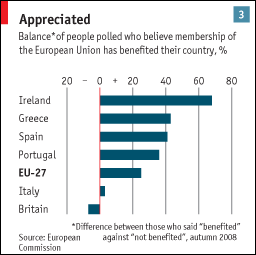
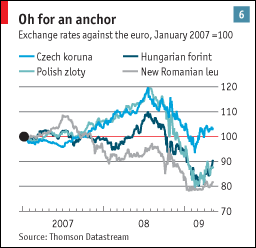
In addition, those on the cusp of joining remain firmly committed to doing so. For such economies, the economic crisis has actually strengthened the case for Euro membership. “As emerging economies they are prone to sudden shifts in foreign-investor sentiment, which makes for volatile currencies, so exchange-rate stability holds considerable appeal for them.” Romania and several baltic states have already had to go hat-in-hands to the EU and IMF to ask for assistance in order to stave off a complete loss of investor confidence. Poland is also vulnerable to currency decline, since many of its loans are denominated in foreign currency; it is currently aiming for Euro membership in 2012.

eastern-europe-wants-to-join-the-euro

Concludes the Economist, “For all its shortcomings, the euro zone is far more likely to expand than shrink over the next decade. Most EU countries that remain outside, bar Britain and Sweden, are eager to join.” This is certainly a bit glib, and ignores the imbalances that the currency is at least partially responsible for. Still, the tentative consensus is accepting of the Euro. It’s like the old joke about capitalism - “it’s the worst system– except for all of the others…”

Risk Aversion Sends Euro Lower in Forex Trading

Economic recovery concerns increase U.S. dollar demand in currency trading

The euro is heading lower in forex trading on the currency market as risk aversion sets in. The latest economic data coming out of Europe and Britain are not very encouraging, and that has investors worrying over the speed of an economic recovery. Indeed, with concerns about the economy at the forefront, forex traders are eschewing high beta currencies that offer more risk.

Not only is the euro down in forex trading, but the U.K. pound is as well. The U.S. dollar is seeing some safe haven demand in currency trading, and other low-yielding currencies, like the yen and the Swiss franc, are seeing some gains as well.

Until economic recovery is well and truly underway, there is likely to be more volatility than usually, and some continuance of support for the U.S. dollar in currency trading.

Swiss Continue to Intervene in Forex Trading

The Swiss want to keep the franc lower in currency trading

Rumors that the Swiss have been intervening in forex trading in order to keep the franc lower have been circulating for months. The Swiss themselves publicly admit that they are willing to tamper with the franc’s performance in currency trading in order to keep it from appreciating. Sean Hyman at the Forex Trading Blog points out that the Swiss are likely to keep it up for some time:

The Swiss are intervening in their currency when they notice the franc’s strength. This is likely to continue until their economy no longer suffers from the franc’s appreciation OR until global economic growth is solidly underway to where traders are “franc sellers” once again as they seek out higher yielding currencies at that point.

And, with risk aversion the order of the day, it is no surprise that the Swiss feel it necessary to continue intervening in forex trading

London Session - July 10, 2009 5:32 AM

Risk aversion was evident in the market again today. Stocks are generally down in Europe, EUR/USD is lower and the yen has made additional progress. Yen gains accelerated around the London open before running into sellers, USD/JPY is modestly lower but EUR/JPY and AUD/JPY have both registered significant falls. The USD posed little reaction from comments made at the G8 apparently aimed at its dominance as a global reserve currency. Better than expected industrial production data this morning from France and Italy had little impact. However, insofar as these data come on the back of this week’s better German data they do soften the economic outlook in the Eurozone. UK PPI inflation data was weaker than expected. This will stir up additional interest in what policy decision the BoE will likely take in August following its decision yesterday not to increase its asset purchases plan. Full text »

Asia Session - July 10, 2009 1:20 AM

Asia ended the week in a rather quiet fashion today, with no notable data on the docket and no real news to drive the markets, many traders seemed to be relegated to the sidelines as spectators only. Regardless of the fact that US equities were higher earlier, Asian stocks were mixed early and risk aversion was ever so slightly apparent as the Yen and Dollar both took steps higher in thinned trading. EUR/USD continued south after hitting a weekly high of 1.4070 in NY, the pair entered the day at 1.4020 levels, and touched just above 1.3960 on the downside. GBP/USD was softer as well, dropping about 70 pips to its low of near 1.6268. The Pound reversed to just short of 1.6325 as the day progressed and Asian stocks looked to end a losing week higher for the day. Full text »

New York Session - July 9, 2009 4:47 PM

Risk appetite was back and this proved detrimental to the US dollar in NY trading. Better economic data in the form of an improvement in jobless claims got the ball rolling early on. US initial jobless claims fell to 565K from 617K the prior week and this was decidedly better than the market’s expectation for a 603K result. Ostensibly, earlier than anticipated shutdowns in the auto space made the number crunching notoriously difficult and as such we would take the number with a grain of salt. The market liked the more upbeat news. Full text

Boris Schlossberg Joins CNBC in Dollar Discussion

Is the dollar facing the possibility of being replaced?

GFT’s Schlossberg says the US dollar is not in any immediate danger.

Meltdown for USD/JPY in Currency Trading

Forex trading with the Japanese yen

Yesterday, the U.S. dollar had a complete meltdown in forex trading against the Japanese yen. This was relatively surprising at first, since the dollar has been expected to do better than the yen as economic conditions improve. GFT’s Kathy Lien explains the USD/JPY meltdown in FX360:

U.S. interest rates are also sharply lower with bond yields falling across the board. The narrowing spread between 10 year U.S. Treasuries and 10 Year JGB (Japanese Bonds) yields may have also added pressure on the currency pair. Japan also imports the majority of its oil and therefore the continual slide in crude prices provides exceptional relief for the Japanese economy and finally, the IMF released its updated growth forecasts and based upon their projections, sharply higher growth is expected in Japan next year. As you can see, it was a combination and not a single factor that triggered the meltdown in USD/JPY.

Today, the U.S. dollar appears to be on the road to recovery in currency trading against the Japanese yen, moving higher even as it falls to the euro and the sterling

Bank of England Keeps Interest Rate Steady

Sterling gains against U.S. dollar in forex trading

The U.K. pound has been having a bit of a rough week in currency trading. However, things appear to be looking up right now. The Bank of England announced its interest rates decision today, and decided to hold the rates steady at 0.5%. In addition to that, British policy makers also announced that they would continue with quantitative easing programs, instead of expanding them.

The news that Britain feels confident enough in economic recovery to avoid expanding its stimulus attempts helped the sterling gain against the U.S. dollar this morning, after dropping below 1.6000. The U.K. pound has recovered, surging ahead after the interest rate decision. The decision shows that Britain recognizes the need to keep rates low for now, but the fact that the country will not expand quantitative easing efforts indicates that there is a fear of inflation, and that means the economy could be showing signs that growth is on the way. All og this is positive for sterling in forex trading.

Yen Strengthens Against the Dollar: What’s the Cause Between the Complete Breakdown?

Did the S&P’s performance affect the Dollar-Yen? Find out by watching Kathy as she reveals her research about this important correlation

Dollar-yen makes a big move but is the correlation between US equities and the currency pair enough for traders risk appetite to return? What does a higher yen mean for currency traders? Watch as Kathy Lien reveals her analysis about not only the yen’s latest move but also the Eurozone and beyond.

Click Here to Watch Kathy Line on Bloomberg News Video

London Session - July 9, 2009 5:49 AM

A reversal of yesterday’s rush into safe haven currencies has been the predominate theme of the session. News of a 48% rise in Chinese car sales in June and the release this morning of better than expected May trade data from Germany showing a rose in 0.3% m/m rise in exports has helped offset pessimism regarding the global economic outlook. The German trade data comes on the heels of this week’s stronger than expected German industrial output and factory orders data. The related better tone in stock markets combined with verbal intervention from a Japanese government official has stimulated buying in ‘riskier’ currencies and squeezed the yen lower across the board. Full text »

Asia Session - July 9, 2009 1:55 AM

Today’s session saw the Yen slip off of its massive NY session gains that were sparked by traders seeking a safe haven in a risk adverse climate brought on by concerns over global growth. After peaking mid day in NY on almost 2% moves against both the Euro and Dollar, the retracement began, and the follow through continued into Asia with the Yen falling amidst a flurry of sales. The dollar received the same treatment, as cooler heads prevailed from the earlier panic to flee riskier assets. USD/JPY continued to bounce from its earlier 5 month low of 91.80, pushing from a 92.80ish open to break the 93.50 level before a 25 pip retracement to end the session. After an earlier collapse from 131.50 to just over 127.00, EUR/JPY opened the day just under 129.00 and drove a full big figure higher to flirt with 130.00. GBP/JPY produced an even more dynamic move, grinding higher from 148.10 session lows to highs near 150.45, only two big figures short of yesterdays highs. AUD/JPY and NZD/JPY both posted nice gains as well.
Full text »

New York Session - July 8, 2009 4:54 PM

Some NY session deja-vu as risk aversion was once again back in full force. Concerns about global growth were apparent as China ostensibly canceled a large order of coal from a major trading partner. Equity marts managed to crawl back to respectable levels but were extremely heavy throughout the span and this weighed on so-called risky currencies. Traders flocked to the yen for no other reason than to unwind carry trades on the back of the selloff in shares. Full text »

Kathy Lien Discusses the Main Focus of the Markets

FOXbusiness.com LIVE ShowGFT’s Lien explains why main focus of the market is on risk appetite

Forex Trading Forecast: USD/CAD

Greenback losing steam against the loonie in currency trading

The forex trading forecast for USD/CAD looks to be weakening. On Monday, the greenback hit a one-month high against the loonie in currency trading, but since then the U.S. dollar seems to be losing steam.

The Canadian dollar is likely to do well as economic data shows some improvement. While the economy is not improving as quickly as some would like, there are still signs that things are looking up. Kathy Lien offers a forex trading forecast for USD/CAD in FX360:

We expect a further sell off in the currency pair on the heels of much stronger than expected economic data. The IVEY PMI report which measures manufacturing sector activity rose to the strongest level since September while building permits surged.

While the economy is improving in fits and starts, the general trend is toward improvement. And that means that the loonie is likely to be supported in forex trading as global trade improves, commodities gain and the stock market recovers

Using Fundamental Analysis and Technical Analysis Together

Making better forex trading decisions

Many forex traders divide themselves into camps: Fundamental analysis and technical analysis. Fundamental analysis looks at the "big picture" factors that influence a currency’s direction. Technical analysis is about watching the charts and making forex trading decisions based on price action.

However, it is not necessary to pick one type of analysis over the other. You can actually practice both. Sean Hyman offers this in an interview with The Forex Blog:

You see, fundamentals tell you what is best to trade, but not when. Technicals tell you when to trade but not what’s actually the “best” currency to trade. Therefore, I use the fundamentals to pair up the strongest currencies with the weakest currencies and look to buy those pairs upon technical entry signals. So I feel that one doesn’t have to be in “one camp or the other”. Both can compliment each other.

It’s an interesting way of doing things, and one that can yield better forex trading decisions and results.

London Session - July 8, 2009 5:38 AM

Profit-taking has taken the edge off Full text »

Asia Session - July 8, 2009 2:13 AM

Another thriller of a session in Asia as traders watched as the Yen took off higher like a speed demon right out of the gate, as risk aversion came screaming back into the market amidst uncertainty in the global economy. Traders watched the Yen fly away to six week highs against both the Euro and the Dollar, as investors were unable to keep the faith that the global economy was emerging from dangerous straights. This view was reinforced by bad Japanese machinery order data, which last month came in at -5.4% and this time around was forecast to be a positive 2.3% but came in at a very disappointing -3.0%, it however, never threatened what looked like a truly invincible Yen. EUR/JPY began its slide right from the open in Asia as traders beat it down over a big figure to just under 131.00. GBP/JPY suffered the same fate, dropping over 150 pips to near 151.50 lows. The Yen crosses have given those investors who were short reason to smile so far this month, as EUR/JPY for instance has collapsed almost seven big figures. Don’t let it get you down if you are one of the many who are asking, whatever happened to the “green shoots” of recovery? It might seem that at this point those who touted the “green shoots” were a bit premature in their euphoria, as recent losses in equities as well as optimism have clouded the horizon. Full text »

New York Session - July 7, 2009 4:54 PM

Risk aversion was the flavor of the NY session as yesterday’s equity market rally fizzled. The S&P 500 sank more than 17 points and closed below the 200-day SMA which came in at 884.99 today. This is a bearish technical signal, but we still need below the 875 support zone to shift the focus decidedly lower here. Oil came off the boil another -2.3% to a close below /bbl as concerns about sustainable global demand permeate the marketplace. This flight to safety benefited the USD first and foremost as the near 90% negative correlation with stocks witnessed in 2009 thus far was in full effect. Full text »

Australian Rate Remains at 3%

Will the Aussie be able to maintain its yield in forex trading?

One of the things that has made the Australian dollar so popular in currency trading on the FX market in recent months has been its relatively high yield. Of the industrialized nations, Australia has the highest yield at 3%. Today, the Reserve Bank of Australia left its rate at 3%, citing still-robust inflation.

However, there are concerns about how long Australia can keep its yield so high. Economic data is starting to show signs of wear and tear on the economy, and there is speculation that the RBA will have to ease its monetary policy further later in the year. But, with the yield where it is at, Australia has room to do so.

Swing Trade Just 10 Minutes a Night

Hi!

Did you grab your copy of the Trade Management Software? If not, what are you waiting for?! It’s 100% F/R/E/E. (no shipping and handling, no back-end monthly installments, no catches) - now isn’t that refreshing?

Get it now before all copies of this Forex tool are gone:

http://www.netpicks.com/cmd.php?af=1004071

If you saw my last post you remember that the software works on every trading system out there. The developers have been using it to help trade the EURJPY and AUDUSD and they managed to pick up pips with a strategy that takes just 10 minutes a day.

Check out their results here:

http://www.netpicks.com/cmd.php?Clk=3087725

Whether you’re trading the EURUSD that everyone knows or something more obscure, with this strategy you’ll never have to micro-manage any of your trading. The days of agonizing over what to do in this situation or that situation are gone.

"click to read more and download........."

Emerging Market Currencies Witness “Correction” as Risk Aversion Rises

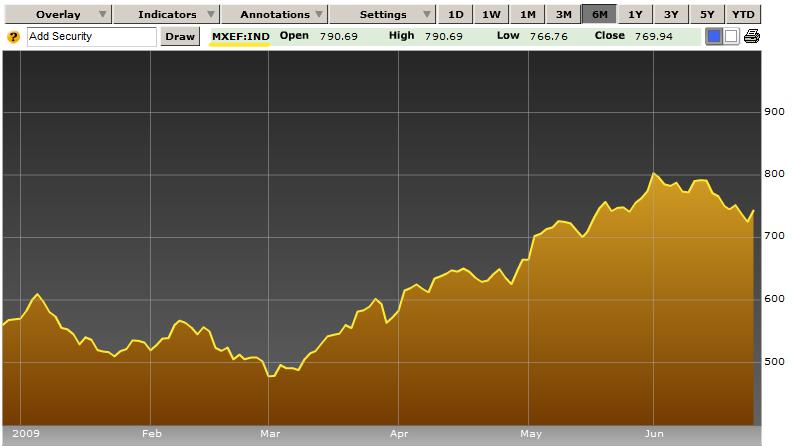
Since peaking in the beginning of June, the MSCI emerging markets index has fallen nearly 10%. While this is small potatoes compared to the 60% rise that the index cranked out in the previous three months, it could signal the beginning of a “correction.”

msci-rises

Around the peak a couple weeks ago, the Forex Blog reported that emerging market stocks had become quite expensive, relative to historical P/E ratios. It’s hard to say whether investors were/are operating under similar assumptions when the market pulled back, or rather if they have been driven by other factors. This is because emerging market currencies, like many other asset classes, have experienced a disconnect from fundamentals of late, such that the ebb and flow of risk aversion - rather than any substantive developments - now dictates the movement of asset prices.

Analysts looking for clues into why specific currencies were rising against the Dollar ignored the fact that virtually all currencies were rising, albeit some more than others. In other words, it was a Dollar-negative story as much as it was an emerging markets story. Likewise, risky investments are losing value across the board now that risk aversion is back in fashion, not because of a perceived change in emerging markets growth potential.

Still, there is much to be nervous about. Latvia still hasn’t dealt with its currency, which some experts think needs to be devalued by as much as 50%. Turkey has yet to sign a loan agreement with the IMF. Russia’s benchmark stock index fell 20% in one day. One of the best proxies for risk levels are credit default swaps, which function like insurance on bonds. If a company/country were to default on its bonds, a holder of a credit default swap contract would be compensated by the writer of the contract. Suffice it to say that credit default swap premiums, especially on emerging market debt instruments, are once again rising, as investors become more worried about the possibility of default.

Generally, the Yen is viewed as one of the most viable currencies during periods of heightened risk aversion. So is the Dollar for that matter, but the Yen has less baggage, vis-a-vis quantitative easing, etc. Sure enough, the Yen has pulled back tightly of late, rising almost 3% in one day against the Euro alone. [In the current market environment, I think it makes more sense to compare the yen with the Euro, since the two currencies are viewed as fulfilling different purposes for currency traders. The US Dollar, in contrast, is currently being driven by some of the same themes as the Yen, which can make it difficult to use this pair to distill changes in risk appetite.]

euro-falls-against-yen

In short, as the global economy reaches a critical phase in the recession, investors will be looking for confirmation, either that a recovery is nearby or still far away. Right now, the consensus seems to have swayed towards the “recovery is faraway” side. However, a sudden uptick in a widely-watched economic indicator could send the pendulum swinging right back in the opposite direction.

13 Forex Pairs Analyzed on the fly!

We are going to be doing something a little bit different today as we analyze the forex markets. Examining the forex markets is nothing new, but we have never gone through 13 pairs of cross rates on the fly. I also show you a quick and effective way to analyze the dollar index at the same time.

In my new video I look at all the major cross rates in a way to quickly tell if you should be in or out of the market.

I am basing my forex observations on our “Trade Triangle” technology and will gladly show you how we apply them to any currency cross rate. It is a quick and easy lesson that will show you exactly what I look for when I’m going to go into a market.

http://www.ino.com/info/379/CD3336/&dp=0&l=0&campaignid=3

The video is free to watch and there is no need to register. I would love to get your feedback about this video on our blog.

All the best

Swing Trade Just 10 Minutes a Night

Hi!

Did you grab your copy of the Trade Management Software? If not, what are you waiting for?! It’s 100% F/R/E/E. (no shipping and handling, no back-end monthly installments, no catches) - now isn’t that refreshing?

Get it now before all copies of this Forex tool are gone:

http://www.netpicks.com/cmd.php?af=1004071

If you saw my last post you remember that the software works on every trading system out there. The developers have been using it to help trade the EURJPY and AUDUSD and they managed to pick up pips with a strategy that takes just 10 minutes a day.

Check out their results here:

http://www.netpicks.com/cmd.php?Clk=3087725

Whether you’re trading the EURUSD that everyone knows or something more obscure, with this strategy you’ll never have to micro-manage any of your trading. The days of agonizing over what to do in this situation or that situation are gone.

This is a simple system that gives you:

*exact entry prices

*income targets

*protective stops

=>>nothing is left to chance

As you can see it’s possible, I mean, these guys have really nailed it. This video shows you exactly how it’s done. Watch the 10 minute sneak peek and receive some awesome nuggets of wisdom to keep in your Forex toolbox.

http://www.netpicks.com/cmd.php?Clk=3087725

Good Trading!

Forex Trade Management Software at No Cost

Hi!

A forex trading friend of mine just forwarded me this new piece of
trading software… and after trying it out I knew I had to pass it on to
you.

After seeing what this software can do, I can honestly say it WILL save you
countless hours figuring out ‘the little things’ when you trade the
Forex… you know: exact position sizes, statistics of your trade
performance, not to mention currency pip values. It’s covers the small (and
sometimes time-consuming) minutia that really add up to make a BIG
difference.

And here’s the part where you’re going to want to thank me. The creators of
this software are GIVING it away:

Check-it-out now:
http://www.netpicks.com/cmd.php?af=1004071

What’s more, the software works across all trading strategies! Seriously.
It doesn’t matter if you trade one of their systems, your broker’s, or even
your own personal method - this Trade Management Software will apply and
help you out tremendously.

Download it here:
http://www.netpicks.com/cmd.php?af=1004071

Plus, I know that the creators of this cool little tool are ‘the real deal’
- meaning, they focus on alot of great principles that are essential to
becoming a successful, well-rounded trader. (and it’s awesome that they’re
giving this software out for NO charge…)

So get to the download page ASAP!

Good Trading!
P.S. I’m not sure how long this will be available before they figure out
they should be charging for this…

so download yours now before they wise up :)

http://www.netpicks.com/cmd.php?af=1004071

ZuluTrade Adds New Supported Broker - Prime4x

zulutrade_logo.jpg

ZuluTrade, the popular forex signal provider platform, has recently added another forex broker to their supported brokers list. This new broker goes by the name of Prime4x. This broker is apparently registered offshore - Cyprus to be precise. Thus they aren’t regulated as far as I know (maybe someone can correct me on this one), although I believe Cyprus has some sort of financial services government regulatory body.

Would I recommend this broker to all you ZuluTraders? Hmm, nope. The reason being that as I was doing my research on them I came across quite a lot of worrying info and user reviews. Have a look at this:

http://www.forexpeacearmy.com/forex-forum/scam-alerts-folder/4069-prime4x-scam-bucketshop.html

For user reviews see this link:

http://www.forexpeacearmy.com/public/review/prime4x.com?page=0

In the end it’s up to you guys what broker you use with ZuluTrade. I don’t want to seem as if I’m telling you what to do, but just make sure you do your homework first. You have seven brokers to choose from, so choose wisely!

Until next time, happy and profitable trading to you all!

FapTurbo Swiss Edition is coming

fapturboswiss-logo.png

Greetings everyone. It looks like the FapTurbo crew has been up to something lately. I haven’t heard much from them for such a long time, and then they come out with news of a “Swiss” edition of their wildly popular fapturbo EA. Not surprisingly they are going to call it FapTurbo Swiss Edition (lol not very creative I know but, whatever). You may be wondering how the heck an EA can be “Swiss” or whatever, so please read this news release that I received because it will clear things up (I’m on their mailing list):

*Btw, the reason they call it “Swiss” is because this new forex robot will use a Swiss ECN forex broker with very low spreads called Dukascopy.*

I have to apologize for not letting you in earlier on our
future project but I did give some hints in our last video
didn`t I? Now since some beta testers absolutely couldnt
keep quiet, It`s about time for something official…

YES we worked the last 8 months on a forex robot.. YES it
was because of the spread issues with fapturbo and .. YES..
it has fantastic spreads…

Now imagine a forexrobot working like fapturbo on a
plattform that has ultra low spreads.. + a few enhancing
features to increase its potential even more?

Now before you get all excited I have to tell you that this
time the copies have to be truly limited.. only a few
persons will be able to grab this opportunity during our
launch (starting 25 June) because we need to limit the
spreading and want those that take up the chance to get a
copy allow to trade at maximum performance.

Fapturbo has been reprogrammed from the ground up for one
specific brokerage outside of metatrader 4 leaving the
“childsplay” so to say behind trading it in for ultra low
spreads and lighting fast execution..

Since you are on the fapturbo list, there is no need to
worry .. you will be the first to get each and every detail
on this monster robot. We will even hold 2 webinars before
we sell out the few copies we are willing to let go off and
show you some astounding real money (you know us we don`t
waste time with demo bull) trading examples.. and a few
beta testers accounts along the way ;)

It`s going to make your eyes fall out (the comic like way)

So stay tuned for more.. as usual great to have you aboard
the ride and best wishes!

Steve

Marketing Manager

ForexKiller
wilhelm greilstr 14
innsbruck
tirol 6020″
Austria

Huge bonuses announced for Forex Income Engine 2.0 (+ webinar replay)

If you missed today’s “emergency” webinar with Bill Poulos
addressing the key mistakes Forex traders make and how Forex
Income Engine 2.0 addresses them, then I have GREAT news for
you…

They recorded it.

Here’s the cool part:

– Bill explained how his groundbreaking Forex Income Engine
2.0 course takes the key mistakes traders make and turns
them into your ADVANTAGE.

– He also used a live chart to detail these mistakes,
reveal the actual strategies from his course

– and then he spent 30+ minutes doing a live Q&A!

I would bet your Forex trading will likely improve JUST by
watching this webinar.

You can get access to the replay HERE:

http://www.customfxtrading.com/y/?i=773362&u=2&l=f68

Plus, Bill announced two killer bonuses during the webinar,
too, and originally said they would expire at 11:59pm,
TONIGHT (Thursday).

However, he decided to extend them another 24 hours to
11:59pm on Friday. But with only 23 copies left, these won’t
last. Get to the replay here:

http://www.customfxtrading.com/y/?i=773362&u=2&l=f68

Enjoy!

Good Trading
Alan

p.s. Now I have bad news…

The last check on their real-time inventory counter showed
only 10 copies remaining. Watch the replay and hurry to see
if there are still any copies left.

http://www.customfxtrading.com/y/?i=773362&u=2&l=f68

A $1,997 Options Trading Course Yours For No Charge

This is not exactly forex related but I could not resist not
telling you about this opportunity!

You may have already heard the “buzz”, but just in case you
haven’t, I wanted to let you know about this straight away.

Every now and then you hear about something so out of the
ordinary, so unusual, that you have to stop and take notice.

Rumors have been spreading on internet ‘message boards’ and
‘blogs’ for the last couple of days that the guys over at
The Options University are about to start GIVING AWAY…

Their Options Mastery Series Course worth $1997!

Rumor has it, the cost will be zero. It will be F.R.E.E.

The “buzz”, rumors and innuendos have been building in the
online trading and investing circles for some time now…

And perhaps you’ve even heard some of them.

Let me be the first to lay them to rest…

The rumors are true!

Brett Fogle, President of OU, is about to start GIVING AWAY
their Options Mastery Series course (OU’s flagship product)
that others have paid as much as $1,997 for in the past…

http://www.optionsuniversity.com/iscript.php?3440_A97484_21637

Why would he do that?

I don’t know… (He’s possibly lost his mind)

What I do know, is that this is one of the best (If not THE
BEST) Home Study Courses on Options Trading on the market!

And as long as he’s going to be GIVING IT AWAY, I think you
should take advantage of his temporary lapse in judgment,
and reserve your copy now before he comes to his senses.

His reasons are below (which I think you’ll find inspiring)
but RIGHT NOW I think you should view this eye-opening new
video that they’ve just put up online.

This impactful video reveals:

* An entirely new perspective on your trading in volatile
markets like these (and why you should be paying attention)

* While the ‘herd’ got slaughtered last year, how the smart and
savvy investors made out like ‘bandits’ using options.

* Undeniable proof that Ron Ianieri and Options University have
been calling this market meltdown for well over a year, and
showing their students how to profit… and profit Big-Time…
using options all the way down!

* Important new reasons why now is the BEST TIME IN HISTORY to
be learning options and using them not only to protect against
losses, but also to get ‘back in the black’ much faster than
with stocks alone.

* And most importantly, how to get a personal copy of the $1,997
training course on options (their Flagship Product) totally
without charge… and another $970 in complimentary bonuses and
monthly ‘continuing education’ training.

Ok, so why is Brett and Options University doing this?

It’s because they believe we’re headed for even more market
volatility in the future, and we may have only just seen the
beginning of the US market meltdown.

He says:

“We could put in a bottom here, but we’ll likely go much lower
with the U.S. Commercial Real Estate market on the verge of
collapse, and residential home foreclosures at record numbers
(so high, the banks can’t officially ‘post’ them all)…

…Which means U.S. banks are also in danger.”

Basically, he wants to let you know that they CARE about U.S.
investors, and want to get this information into the hands of
as many of you as possible… lost income to them be damned!

They’ve also developed some NEW proprietary tools and scanners
to help you find better trade setups, which they’ll give you
complimentary access to soon as well.

So here’s what I recommend you do next…

Watch the video, and then get on the early notification list:

http://www.optionsuniversity.com/iscript.php?3440_A97484_21637

You’ll then be able to reserve a complimentary course, plus
$970 worth of ‘Continuing Education’ over the next 12 months.

But there is one ’small catch’…

Brett said he can only allow 1,000 courses to be released. After
that, they’re ‘closing the doors’ because there’s only so much
they can ‘foot the bill’ for… (Generosity has it’s limits.)

After all, that’s $1,997,000 in lost potential income to Options
University, and that’s apparently as much as he can stomach.

Plus, they don’t want to make all their past customers who have
paid nearly $2000 for the course screaming mad at them.

So I suggest you go there now, because…

This email is likely going out to over 200,000 active traders
and investors. And they are giving all of their ‘preferred
partners’ like us first shot at letting our subscribers ‘in’
on this great deal… So these WILL go fast!

This is truly a case of “you snooze, you lose.” Don’t delay.

P.S. Don’t miss this rare chance to get your hands on Options
University’s flagship product - their Options Mastery course
(worth $1,997)… plus another $970 worth of bonuses…

… Absolutely F.R.E.E!

P.P.S. But here’s the ‘Bad News’…

Brett can only let 1,000 sets go out. And this email is going
out to at least 200,000 active traders and investors TODAY.

To get on the early notification list for reserving your set
all you have to do is watch a short video and leave your name.

Here’s the web page to do that right now…

http://www.optionsuniversity.com/iscript.php?3440_A97484_21637

Fixes the top 2 mistakes you make with Forex (webinar)

No matter how you trade Forex, you probably don’t want to place
another trade until you make sure you aren’t making these 2
critical mistakes that most traders make.

Keep reading, because this is your ONE AND ONLY official invite
to an “emergency” webinar being held tomorrow, Thursday, June
18th at 4pm Eastern by Bill Poulos, developer of the Forex
Income Engine 2.0 home study course that’s already been snapped
up by nearly 1,000 traders in just the past few days.

(Plus, Bill has a few surprises you’ve NEVER seen before that
will be revealed on the webinar that you will NOT want to miss.)

Register HERE:

http://www.myflexibleforex.com/y/?i=773362&u=2&l=f67

As of this writing, Bill says he only has about 200 copies of
his course left of the 950 copies he initially planned to
distribute.

That means they’ll probably sell out any day now.

HOWEVER…

Bill’s student support center continues to be slammed with
questions about his new course (this comes as no surprise to
me, since over 100,000 traders have visited his website in
the past week)…

-and there seem to be a few questions that traders like you
keep asking him again and again…

So, to save his support staff some time, he thought it would
be best to hold an “emergency”, last-minute webinar where
he’ll address these top questions for everybody, ALL AT
ONCE.

Specifically, he’ll be yanking some of the best content
straight out of his Forex Income Engine 2.0 course and
revealing it live on the webinar:

* How to create an “infinite” risk/reward ratio when you
trade Forex, regardless of what pair or timeframe you
trade…

* Why most traders actually LOSE money when they try to
capture a market’s entire move, and how you can turn this
into your advantage when you know the exact part of a market
move you should be going after…

* …and a TON more.

————————————————–
3 LUCKY TRADERS WALK AWAY WITH A COPY ON THE HOUSE
—————————————————

Since Bill expects a huge turnout for this webinar, he
wanted to spice it up a little and add a super fun element
to it…

-so, he spoke with some of his trading education partners
and got 3 of them to agree to give away their personal
“preview copies” of the Forex Income Engine 2.0 to 3 lucky
traders live on the webinar.

All you need to do to get a copy is SHOW UP.

* You MUST be present to win. We will announce the lucky
traders “live” and make arrangements for shipping privately
with them during the webinar.

ALSO… each copy we give away will be bundled with a
different HUGE trading bonus that each of his 3 trading
partners is “kicking in” to sweeten the deal.

——–
SURPRISE <– stick around for this one
——–

And if that’s not enough, at the end of the webinar Bill has
a few more big surprises for you that you will NOT want to
miss.

Trust me.

To claim your virtual seat for this webinar, go ahead and
register here NOW:

http://www.myflexibleforex.com/y/?i=773362&u=2&l=f67

It’s a near certainty that this webinar WILL be filled to
its technical limit, so after you register, plan on showing
up early to make sure you get in, because…

-once the room fills up, you will be LOCKED OUT.

Again, it’s all happening on Thursday, June 18th, at 4pm
Eastern (New York time).

See you then.

Good Trading!

Dollar Appreciates on Better Economic News

U.S. dollarThe U.S. dollar continued to gain today after the yesterday’s rather significant rally as the speculations that the world’s biggest economy is soon to leave its recession period arise.

The dollar grew against the euro and the British pound today, while being almost unchanged versus the Japanese yen. Yesterday, after the fundamental indicator news were released along with some corporate reports, the U.S. dollar advanced against all major currencies that are traded on Forex. The overall picture is definitely improving for the United States.

A somewhat unique flavor of the current situation lies in the fact that the dollar gains on good U.S. news, whereas previously good fundamentals from U.S. were benefiting only for their stock market and were very negative for the dollar. It looks like the traders now need to buy the greenback not only to get into a «safe haven» (and U.S. looks extremely safe comparing to other big economies) but also to buy the U.S. stocks, which promise huge earnings to the greedy investors that have enough courage to enter the market today.

The currency analysts point at the banks’ Q1 2009 reports (Wells Fargo’s being most prominent) as the main moving factor for the dollar. The say that more investors would want to buy dollar to use for the entry into the U.S. private financial system.

EUR/USD fell from 1.3156 to 1.3142 as of 11:05 GMT today after reaching as low as 1.3088 earlier — the minimum level since March 18. GBP/USD declined from 1.4670 to 1.4611, whole USD/JPY remains virtually unchanged near its 100.40 open level.

Aussie and Kiwi Gain as Risks Decrease

New Zealand dollarThe currencies of Australia and New Zealand advanced against the Japanese yen and the U.S. dollar on the Forex market today as the traders clearly favored risk-ridden high-yielding assets despite the mixed stock trading session results in Asia.

The growth of the high-yielding currencies was spurred mainly by the decline of the Japanese yen, which was clearly overbought during the last week. The gains in both Australian and New Zealand stock exchanges were quite moderate. Nevertheless, the Australian dollar managed to reach a new high level since October 2008 against the yen.

The analysts believe that as long as the U.S. banks continue to report good results for the first quarter of this year, the risk-averting trends will continue to decline on the currency market. The yen is likely to fall further, while such currencies as the Australian and New Zealand dollar are going to gain from these fundamental developments, albeit in a short to medium term.

AUD/JPY rose from 72.45 to 72.85 as of 9:52 GMT today after reaching as high as 72.99 earlier — the maximum since October 14, 2008. NZD/JPY wen up from 58.75 to 58.96; AUD/USD advanced from 0.7217 to 0.7238; NZD/USD increased from 0.5853 to 0.5858, while AUD/NZD rose from 1.2315 to 1.2342.

PIPBOXER + GRIDBOXER ONLY $999

This is the best deal I’ve seen come accross from the folks over at Investtech, makers of Pip Boxer and Grid Boxer EA’s for Mt4. These EA’s help identify logical ranges based on statistical volatility. You can buy these EA’s for one currency at a time, OR, buy the complete package. Well, until March 15, 2009, you can receive the entire package of both GridBoxer and PipBoxer at 63% off the original price.

pipboxer_v4_strategy

There was a time I just could not afford this package let alone a multitude of these EA’s individually. Now, I can totally afford this, since I made at least 380 pips this month alone, I can afford purchasing Pip Boxer and making even more pips on AUTO PILOT! It’s sad that the sale ends March 15, so get your copy TODAY before it’s too late.


I had a chance a year ago to try out Pip Boxer, I paid for a demo, $5 or $10, and it really did work. My only concern was I didn’t have enough money to actually buy these EA’s individually or in a package. I could never decide which EA to get for what pair, which is my own personal problem of failing to make a committment, ask my ex-girlfriends. But in all seriousness, I just have enough to actually purchase PipBoxer and GridBoxer in a package deal for $999 (a savings of over $1700). pipboxer_method-2

How I plan on using PipBoxer and Gridboxer is to set them up on at least 10 different currencies accross 10 different charts for a few weeks on demo mode. I would like to see which system works the best with the settings Investtech recommends, then, finely tune it to my own style of trading with respect to money management, logical stops, and pivot points, which the software does not take into account. PipBoxer isn’t the be all end all system, but it really takes alot of the guesswork out of trying to find out where a good entry and exit is, not where it “might” be. This EA can help you trade live, or just give you alerts, but this can be considered an automated forex bot/ system.

You won’t find PipBoxer or Gridboxer free anywhere on any sharing sites, each copy is activated one by one ensuring the integrity of your investment.

My Final Forex Killer Review

Well, it’s not much of a review, rather than a final comment on why this software really isn’t worth your time. Like I’ve said many times, Forex Killer works just fine, but there are other things out there to help you trade that are much more worth your time and in some instances free of cost to you.

I decided to make this post because I still see a large portion of my visitors searching for Forex Killer in some way shape or form. Most people ask, Is Forex Killer a Scam? Well, I do believe Forex Killer does exactly what it says it does. But perhaps it shifts focus off of a trader’s inherent responsibility to actually learn how to trade, with promises to make you rich simply and without stress. I’ve come to appreciate a healthy amount of stress while trading, careful to not get too comfortable in any one method, following any one indicator, or any one signal provider. The market is always changing, evolving perhaps, adapting definitely, so what works one day may not work the next.

While it’s not necessary for a forex trader to be “aggressive” in his trading style, I believe just trading with Forex Killer in one’s system is not proactive enough to make “a killing” like the software promises. 11-12-08-multimap-flips.png The whole idea of cutting and pasting the last X amount of closing prices then calculating which way the trend is can easily be found in a number of different indicators and methods. Seeing recently what TopGun Software can compute and graphically present, for instance, their one of a kind FX Multimap can instantly show you the strength of a pair or an individual currency vs all other currencies. Flips of this Multimap from red to green usually indicator a change of direction or resumption of a previous upward trend. Either way, weakness is disappearing and strength is continuing and this is shown to you in an instant and you did nothing except add this indicator to your chart. Another great thing about Topgun is the recent Narrow Range Breakout Script that intuitively adds lines above and below the levels of important ranges. Used in concert with flips of FX MultiMaps from green to red or red to green, a successful trade becomes all the more likely. Forex Killer could NEVER give you such amazingly simple indications of when to enter a trade. Exiting a trade is just as simple if you just add a trailing chandelier stop. It’s hard to do much of anything with Forex Killer except identify how likely a trade is to go up, but if you took any sort of Forex education, you’d probably hear at some point that you ought not trade on what you think “might” happen, rather, trade based on what you see is happening. TopGun has scores of other indicators I am just learning about, so I’ll keep you updated on this software of the next few months.

The only downside to TopGun Software is that it costs approximately $250 per month to pay for E-Signal feeds and the software itself (free if you sign up for FXCM under TopGun as an Introducing Broker Client).

That is just one big “for instance” when looking for alternatives to programs such as FOREX KILLER. Not much else to say except there is undoubtedly many things better than Forex Killer in the world today.

FOREX KILLER EA?

zinkkiller1The Zink Killer EA is this Expert Adviser for Meta Trader 4 that was programmed by a guy known only to me as “ZINK” that was on a Forex Forums somewhere. It interested me because it was touted to be the AUTOMATIC VERSION OF FOREX KILLER. From the moment I tried Forex Killer I wanted to see if it was possible to make this a completely automated Forex system, cutting out many extra steps that waste time before entering a trade.

He had anyone interested email him for the demo version of the Zink Killer EA, which I did, and it worked pretty well for a while. In fact, the EA, with the right settings, turned out to be profitable more than not. It did get me into some losing trades, which I chalked up to relying to heavily upon the EA entering trades automatically, with little to no logical intervention on my part that might keep me out of a bad trade.

Long story short, the Zink Killer EA stopped working after a few months, the demo must have expired. When trying to find him to get a full version, I never got a reply. There is no Zink Killer website or anything so I am at a loss.

Zink Killer EA

As you can see it was customizable with Trailing Stop, Lot Size, Stop loss, and a few others. I really enjoyed testing this out and want to try it with a few dollars in a small account somewhere. So if Zink comes to this blog, let me know what’s up with Zink Killer, is it discontinued? Is it available? Thanks bud.

New Broker for the List — Wall Street Brokers

Wall Street Brokers is the new on-line Forex brokerage company that was added to the Forex broker list on my site today. It’s a somewhat strange broker that is registered in the United States but isn’t regulated by any institution there. It went on-line in 2008. Other highlights of this broker:

  • Forex, CFD, gold, silver, oil and futures trading
  • Credit card, Moneybookers or wire transfer for deposits and withdrawals
  • Automated trading with signals subscriptions (at a cost of 1 pip per trade)
  • 3 pips spreads
  • Micro accounts from $10 and 1:500 leverage
  • Muslim-friendly accounts (actually ALL accounts bear no overnight interest)

Not So Squeezy Trading Manual and Indicators Package

Today I uploaded a trading strategy manual and the corresponding MetaTrader indicators for the Not So Squeezy Forex strategy. The manual is a 21-page long ebook that describes the method of the strategy and the indicators that are required for it. It’s not a very complex strategy and I can even recommend it for the newbies traders. The indicators package consists of the the required indicators plus some extra that might be useful for the advanced traders (they may wish to modify the strategy).

Forex Technical Analysis for 04/13—04/17 Week

EUR/USD trend: sell.
GBP/USD trend: sell.
USD/JPY trend: hold.
EUR/JPY trend: sell.

Floor Pivot Points
Pair 3rd Sup 2nd Sup 1st Sup Pivot 1st Res 2nd Res 3rd Res
EUR/USD 1.2497 1.2793 1.2990 1.3286 1.3483 1.3779 1.3977
GBP/USD 1.4132 1.4356 1.4511 1.4734 1.4889 1.5113 1.5268
USD/JPY 97.09 98.20 99.22 100.33 101.34 102.45 103.47
EUR/JPY 123.18 127.06 129.63 133.52 136.09 139.97 142.54
Woodie’s Pivot Points
Pair 2nd Sup 1st Sup Pivot 1st Res 2nd Res
EUR/USD 1.2768 1.2941 1.3261 1.3434 1.3755
GBP/USD 1.4339 1.4477 1.4717 1.4855 1.5096
USD/JPY 98.18 99.17 100.30 101.30 102.43
EUR/JPY 126.73 128.97 133.19 135.43 139.64
Camarilla Pivot Points
Pair 4th Sup 3rd Sup 2nd Sup 1st Sup 1st Res 2nd Res 3rd Res 4th Res
EUR/USD 1.2916 1.3052 1.3097 1.3142 1.3233 1.3278 1.3323 1.3459
GBP/USD 1.4458 1.4562 1.4596 1.4631 1.4700 1.4735 1.4770 1.4874
USD/JPY 99.06 99.65 99.84 100.04 100.43 100.62 100.82 101.40
EUR/JPY 128.65 130.43 131.02 131.61 132.79 133.39 133.98 135.75
Tom DeMark’s Pivot Points
Pair EUR/USD GBP/USD USD/JPY EUR/JPY
Resistance 1.3385 1.5001 100.84 134.80
Support 1.2891 1.4623 98.71 128.35
Fibonacci Retracement Levels
Pairs EUR/USD GBP/USD USD/JPY EUR/JPY
100.0% 1.3582 1.4958 101.44 137.40
61.8% 1.3394 1.4813 100.62 134.94
50.0% 1.3335 1.4769 100.37 134.17
38.2% 1.3277 1.4724 100.12 133.41
23.6% 1.3205 1.4669 99.81 132.47
0.0% 1.3089 1.4580 99.31 130.95

New York Session - April 13, 2009 4:19 PM

The lack of top-tier economic events in the NY session had the market trading on technicals. US stocks managed to eke out a modest rally after a rollercoaster of a day that saw equities down as much as -1.3% and as high as +1.0%. Financials surged +4.8% on the day as hope springs eternal that most 1Q bank earnings will surprise to the upside. Gold maintained earlier gains and was sitting near 893/894 ahead of the NY close. The 100-day SMA sits at 884/885 and a close above that area looks constructive for the precious metal. Full text »

Trading Ranges and the FX Market

Using trading ranges in your forex trading strategy

When determining forex trading strategy, it can be helpful to look at the trading ranges experienced by some currency pairs. Wider ranges indicate higher volatility and lower ranges indicate something a little less risky.

It is important, however, to remember that forex trading in general is a rather risky form of investing. GFT’s Kathy Lien offers this insight, via FX360, on using trading ranges in your forex trading strategy:

Being aware of the average daily trading range of each currency pair can help you set stops more appropriately and hopefully increase your selectivity of trades. A 100 pip move in GBP/AUD for example can happen in a blink of an eye and because of that, you could be stopped out on just a minor fluctuation only to see the currency pair move back in your desired direction. It can also help set more realistic expectations. A 100 pip move in your desired direction in EUR/GBP could take days while a similar move in EUR/NZD could take minutes.

Canadian Dollar Gains Against U.S. Dollar in Currency Trading

Loonie advances in forex trading

The loonie is advancing in forex trading on the currency market. The U.S. dollar is struggling today in currency trading, and that is giving the Canadian dollar a chance to make up a lot of lost ground.

Because it is so dependent upon commodities, the Canadian dollar has dropped in currency trading as the market for resources and goods has dried up in response to the global recession. Now, however, there is hope that the economic slowdown may be coming to an end and that commodities may soon be back in demand.

However, the loonie lost so much in forex trading to the greenback that it will take quite a bit of time to catch up. Plus, economic data isn’t helping the cause for the Canadian dollar, meaning that it has a ways to go before it approaches parity with the U.S. dollar, as it did in mid-2008.

President Obama Says Economic Stimulus Under Budget

Transportation projects come in under estimates

President Obama says that the transportation projects meant to receive funding under the recently passed economic stimulus bill are coming in under budget. This is good news he points, out, adding that it means more economic stimulus dollars for other projects. MarketWatch reports on some of the economic stimulus areas seeing savings:

Obama noted that Oregon in February and March reported that infrastructure projects have averaged are 30% below what the state had originally budgeted. He also pointed out that competitive bids for a road project in Louisiana brought in a winning offer that was .7 million less than the state had budgeted for the project.

"As a result we have more recovery dollars to go around," Obama said.

This news is likely to help speed up optimism in terms of the chances of economic recovery. It will be interesting how financial markets take this news. It may not help the dollar much — promoting risk appetite and sending other currencies higher — but it should help the stock market.

 
Top Forex Trading | TNB