Subscribe News Feed Subscribe Comments

Risk Aversion Edges Up

Over the last few weeks, the stock market rally has fizzled and commodities prices have cooled off. It’s not clear what triggered this sudden surge in introspection (I would call it reasonableness). Regardless, the markets are now wondering out loud whether the optimism of the second quarter wasn’t a bit naive.

After all, there still isn’t any evidence that global economy has turned a corner. Virtually all of the economic indicators that matter are still trending downwards. In addition, the apparent stabilization in housing prices could prove temporary, as banks move away from loan modifications and back towards foreclosure. Rumors that the Obama administration are considering a second stimulus plan are already circulating

With second quarter corporate earnings season set to kick off next week, investors are once again bracing for the worst: “Given the strong performance of stocks relative to March lows, a reality check from earnings could be detrimental to risk appetite.” Adds another analyst, “It’s renewed risk aversion, triggered by mounting doubts about a near-term economic recovery that’s evident in the sell-off on Wall Street and the subsequent decline in risk assets in general.”

This pickup in risk aversion is also manifesting itself in forex markets, via the upturns in both the US Dollar and Japanese Yen: “The prospect of a slow and bumpy recovery remained the overriding driver of market sentiment and the dollar was soon reasserting itself as the currency of choice - apart from the yen.” Ironically, negative economic data that applies directly to the US is benefiting the Dollar, which goes a long way towards explaining the current market orientation. Currency traders have yet to turn towards comparative growth differentials (despite the predictions of some analysts) and remain firmly focused on risk. Meanwhile, “The yen rally has extended, driven by the liquidation of long-risk asset positions.” In other words, the carry trade has come under pressure as investors move back into low-risk government bonds.

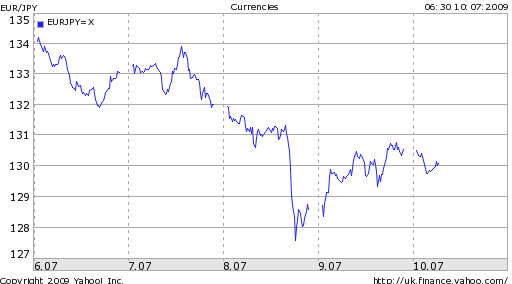
euro-yenThe “uncertainty” narrative will likely continue to drive the markets for the near-term, as neither the optimists nor the pessimists have the data to support their respective positions. In all likelihood, the markets will trend sideways and safe haven currencies will see a slight inflow, until there is confirmation that the economy is firmly on the path to recovery.

Inflation Update: US Prices Creep up in May

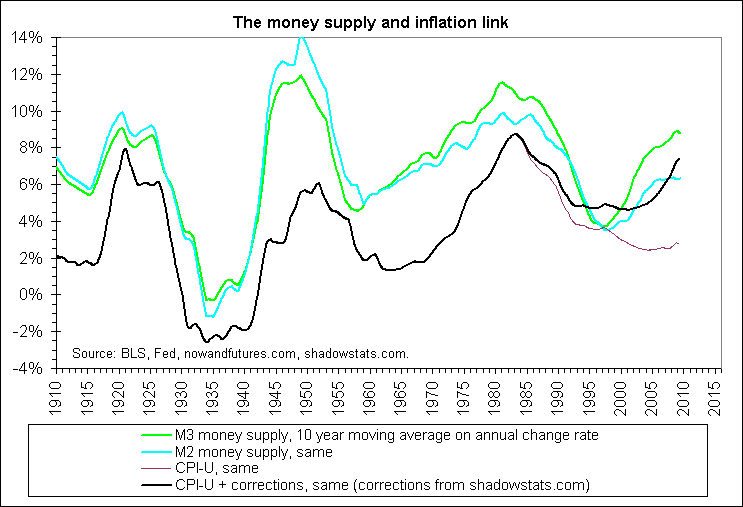
The debate over US inflation continues to be waged- in academic circles, among economists, and in the financial markets. There is no still no clear consensus as to the likelihood that the inflation will flare up at some point, as a result of the Fed’s easy monetary policy and the government’s record budget deficits. While the unprecedented nature of this crisis means that such a debate is still a matter of theory, that hasn’t stopped both sides from weighing in, often vehemently.

Admittedly, the risk of inflation in the short-term is still low: “With so much of the world ensnared by the economic downturn, demand for goods and services is weak, which tends to push down prices. Amid high unemployment, workers are in no position to demand wage increases.” Still, the Consumer Price Index (CPI) is already creeping up. The Fed’s “core” measure, which excludes food and energy prices, rose 1.8% from a year ago. If commodity prices continue to rise, the total CPI could soon become positive. (It currently stands at -1.3%).

Among academics and economists, the discussion is being framed relative to the Fed; specifically, can it - and more importantly, will it - move to unwind its quantitative easing program when the time comes? “If it acts prematurely to reduce the money supply, the Fed could stifle the recovery. If it waits too long, it could contribute to a jump in inflation. Its timing is going to have to be perfect,” says a former Fed economist.

This question remains divisive, as evidenced by the ongoing feud between the chief economist at Morgan Stanley and his counterpart over at Goldman Sachs. MS is concerned that the Fed will leave rates too long. According to one of his supporters, “The Fed absolutely has the tools and know-how, but the question is, will they have the guts to use them? I don’t think there is a snowball’s chance in hell they will be willing to tighten to slow inflation down.” Counters the GS camp: ““The Fed will be able to contain inflation pressures through a combination of raising interest rates and unwinding its balance sheets.”

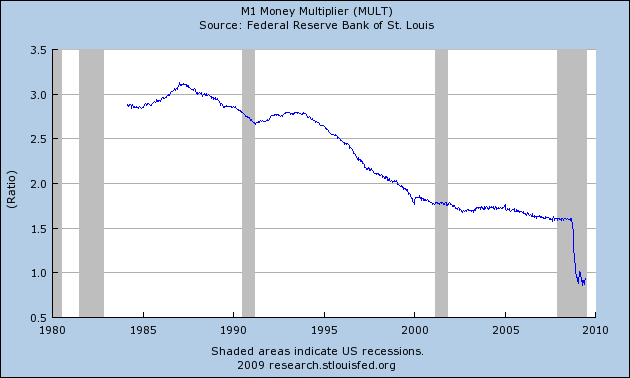
All of this talk seems premature when you consider that the money supply is barely growing, despite the Fed’s QE program: “M2, a gauge that includes savings and checking accounts, is 4.7 times the base cash supply, down from 9.3 times a year ago.”

m1-money-multiplier

“Of the $2.1 trillion that the Fed is injecting into the financial system, more than half, or 51 cents per dollar, is being posted back at the central bank by financial institutions in the form of excess reserves, a record high.” In other words, most of the Fed’s cash is not actually finding its way to consumers.

us-money-supply-and-inflation-link
Financial markets are equally ambivalent, although erring on the side of caution. Treasury yields on the long end of the curve have risen over the last few months, though this can be attributable to several causes. More specifically, “The spread been nominal 10-year Treasury yields and comparable-maturity TIPS yields has increased from approximately 0.25% at the start of the year to 1.65% currently, reflecting a 1.4% increase in expected CPI inflation over the next decade.” Based on this, it’s clear that while investors don’t share the doomsday pessimism of inflation hawks, they are nonetheless growing increasingly concerned.

Interview with Sean Hyman: “Trade with the trend”

As part of our ongoing series, printed below is an interview with Sean Hyman, of World Currency Watch. [Blog found here]. Sean has collected over 15 years of experience as a stockbroker, manager, and trader, working for enterprises as varied as a technical analysis “call in” line for their million dollar+ clients and active traders, Charles Schwab, and FXCM. Over this period, he has refined his trading approach through the use of fundamental/technical analysis and intermarket analysis, and now takes a very “macro” approach.

Read the rest of this entry »

Forex Reserve Growth Could Slow

Most of the recent discussion surrounding foreign exchange reserves has focused on the allocation of those reserves; specifically, whether or not these reserves will be invested in Dollar-denominated assets to the same extent as before. But what if this discussion fails to see the forest through the trees? In other words, this issue is built on the implicit premise that Central Banks will continue to build their forex reserves, and hence they need a place to invest them. With this post, I will examine whether this is indeed the case.

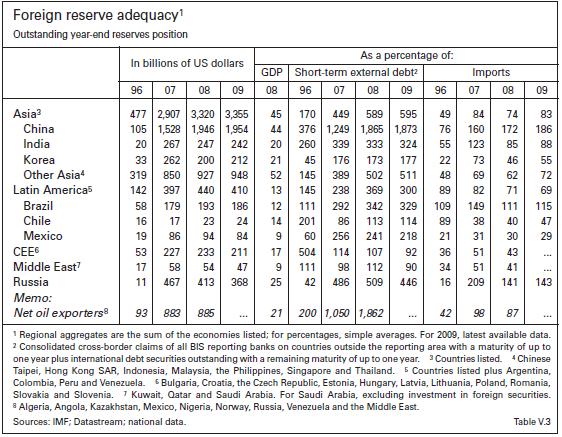
Since the start of the credit crisis, forex reserve growth has slowed as Central Banks (mainly in emerging markets) began to deploy some of their cash: “In the first quarter of 2009, foreign reserves were at 80% of their June 2008 levels in Korea and India, around 75% in Poland and 65% in Russia.” Most of the spending was used for direct intervention in currency markets and to finance capital outflows, as risk-averse investors moved funds out of emerging markets. Russia, alone, spent nearly $200 Billion trying to prevent a complete collapse in confidence in the Ruble.

Thanks to their prudence following the 1997 Southeast Asian economic crisis, however, reserves are still more than adequate based on most measures: “A well known rule of thumb (the so-called Guidotti-Greenspan rule) is that foreign reserves should cover 100% of external debt coming due within one year. In 2008, almost all EMEs far exceeded this threshold – coverage was more than 400% in Asia and Russia and around 300% in Latin America. Another rule of thumb, that foreign reserves should cover three to six months of imports (ie 25–50% of annual imports) was also typically exceeded at the end of 2008.” Even despite the recent declines, coverage remains strong enough to meet financing requirements for the immediate future. China, whose cache of forex is by far the world’s largest, boasts a coverage ratio of nearly 2,000%!

foreign-reserve-adequacyGiven such robustness, it’s clear that the impetus to continue accumulating reserves has eroded slightly. Central Banks have also come to realize how vulnerable they are to credit and currency risk, vis-a-vis the allocation of their reserves, which means that the best alternative going forward is probably to start investing in commodities and/or domestic economic initiatives. China has already begun to move in this direction.

There are several alternatives that are less risky/expensive than directly holding foreign exchange reserves. “First, in October 2008 four EME central banks each entered into a $30 billion reciprocal currency arrangement with the US Federal Reserve. Second, a $120 billion multilateral facility, drawing on international reserves, was recently established in East Asia…Third, recent G20 initiatives have called for large increases in resources for international financial institutions…[such as the] IMF’s recently created Flexible Credit Line.” Such programs provide countries in crisis with the cash to draw from without forcing them to build up reserves in advance.

To be fair, not all Central Banks are prepared to break from the current system. “In spite of significant interventions in the fourth quarter of 2008, many EMEs still had larger foreign reserves at the end of 2008 than they did in 2007.” Reports are coming in that Indian and Korean reserves, for example, have reached their highest levels since the collapse of Lehman Brothers last fall. This is sounding alarm bells for economic officials: “There is a hope the lesson taken away from the current experience is not that these countries need even larger foreign exchange reserves. These things are not terribly efficient. Our concern is that these things are going to be built up even further as a consequence.”

Will the Euro Survive the Credit Crisis?

The Euro has always had a marginal group of naysayers; there were always those who insisted that a common currency didn’t make sense for a region as diverse as the EU. As a result of the credit crisis, a bevy of critics have come out of the woodwork and declared that the Euro will not survive its first official crisis. Are they right?

According to a Special Report on the Euro Area published in the Economist (which inspired this post), the Euro has been a modest success by most measures. “The ECB has fulfilled its remit to maintain the purchasing power of the euro. Since the currency’s creation the average inflation rate in the euro area has been just over 2%. Fears that the euro would be a “soft” currency have proved unfounded. It is unquestioningly accepted at home and widely used beyond the euro area’s borders.” While the Euro hasn’t facilitated meaningful gains in productivity or GDP, it has unquestionably engendered greater stability.

euro-zone-members1

Ironically, the countries that are now complaining the loudest about the Euro are mainly those that benefited the most from its membership. The economy of Spain, for example, “grew at an average annual rate of 3.9% between 1999 and 2007, almost twice the euro-zone average and much faster than in any of the currency area’s other big countries…Unemployment fell from close to 20% in the mid-1990s to just 7.9% in 2007.”

Unfortunately, the economic boom also corresponded with a rise in prices and unit wage costs, both of which are now proving to be particularly painful in the context of recession. Aided by a strong currency, its current account deficit has risen to 10% of GDP. Meanwhile, the same problems are affecting Portugal, Ireland, Italy, and Greece. As the report explains, “The main hazard for investors in high-inflation countries—that a steady loss of domestic purchasing power will drag the currency down—is eliminated in a fixed-exchange-rate zone.”

A country with an independent monetary authority would normally deal with these problems by raising interest rates and/or devaluing the currency. Actually, given how extreme the imbalances are in some of these countries, the markets probably would have accomplished this for them. In this case, however, their membership in the EU and their deference of monetary power to the European Central Bank precludes such possibilities. As a result, the main solutions will have to be originate in the political arena. Wages will have to become more flexible, and labor market controls will have to be loosened, in order to increase productivity.

The alternative - leaving the Euro zone- is unthinkable. “The costs of backing out of the euro are hard to calculate but would certainly be heavy. The mere whiff of devaluation would cause a bank run: people would scramble to deposit their euros with foreign banks to avoid forced conversion to the new, weaker currency. Bondholders would shun the debt of the departing country, and funding of budget deficits and maturing debt would be suspended.” As a result, borrowing costs would increase drastically, which could induce a wage-price spiral. Inflation and currency stability would be tenuous, at best. As a result, it’s not surprising that in most Euro member states, polled citizens remain strongly in favor of the Euro.

support-for-the-euro-is-strong

In addition, those on the cusp of joining remain firmly committed to doing so. For such economies, the economic crisis has actually strengthened the case for Euro membership. “As emerging economies they are prone to sudden shifts in foreign-investor sentiment, which makes for volatile currencies, so exchange-rate stability holds considerable appeal for them.” Romania and several baltic states have already had to go hat-in-hands to the EU and IMF to ask for assistance in order to stave off a complete loss of investor confidence. Poland is also vulnerable to currency decline, since many of its loans are denominated in foreign currency; it is currently aiming for Euro membership in 2012.
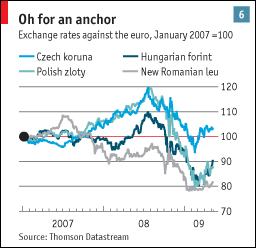
eastern-europe-wants-to-join-the-euro

Concludes the Economist, “For all its shortcomings, the euro zone is far more likely to expand than shrink over the next decade. Most EU countries that remain outside, bar Britain and Sweden, are eager to join.” This is certainly a bit glib, and ignores the imbalances that the currency is at least partially responsible for. Still, the tentative consensus is accepting of the Euro. It’s like the old joke about capitalism - “it’s the worst system– except for all of the others…”

Risk Aversion Sends Euro Lower in Forex Trading

Economic recovery concerns increase U.S. dollar demand in currency trading

The euro is heading lower in forex trading on the currency market as risk aversion sets in. The latest economic data coming out of Europe and Britain are not very encouraging, and that has investors worrying over the speed of an economic recovery. Indeed, with concerns about the economy at the forefront, forex traders are eschewing high beta currencies that offer more risk.

Not only is the euro down in forex trading, but the U.K. pound is as well. The U.S. dollar is seeing some safe haven demand in currency trading, and other low-yielding currencies, like the yen and the Swiss franc, are seeing some gains as well.

Until economic recovery is well and truly underway, there is likely to be more volatility than usually, and some continuance of support for the U.S. dollar in currency trading.

Swiss Continue to Intervene in Forex Trading

The Swiss want to keep the franc lower in currency trading

Rumors that the Swiss have been intervening in forex trading in order to keep the franc lower have been circulating for months. The Swiss themselves publicly admit that they are willing to tamper with the franc’s performance in currency trading in order to keep it from appreciating. Sean Hyman at the Forex Trading Blog points out that the Swiss are likely to keep it up for some time:

The Swiss are intervening in their currency when they notice the franc’s strength. This is likely to continue until their economy no longer suffers from the franc’s appreciation OR until global economic growth is solidly underway to where traders are “franc sellers” once again as they seek out higher yielding currencies at that point.

And, with risk aversion the order of the day, it is no surprise that the Swiss feel it necessary to continue intervening in forex trading

London Session - July 10, 2009 5:32 AM

Risk aversion was evident in the market again today. Stocks are generally down in Europe, EUR/USD is lower and the yen has made additional progress. Yen gains accelerated around the London open before running into sellers, USD/JPY is modestly lower but EUR/JPY and AUD/JPY have both registered significant falls. The USD posed little reaction from comments made at the G8 apparently aimed at its dominance as a global reserve currency. Better than expected industrial production data this morning from France and Italy had little impact. However, insofar as these data come on the back of this week’s better German data they do soften the economic outlook in the Eurozone. UK PPI inflation data was weaker than expected. This will stir up additional interest in what policy decision the BoE will likely take in August following its decision yesterday not to increase its asset purchases plan. Full text »

Asia Session - July 10, 2009 1:20 AM

Asia ended the week in a rather quiet fashion today, with no notable data on the docket and no real news to drive the markets, many traders seemed to be relegated to the sidelines as spectators only. Regardless of the fact that US equities were higher earlier, Asian stocks were mixed early and risk aversion was ever so slightly apparent as the Yen and Dollar both took steps higher in thinned trading. EUR/USD continued south after hitting a weekly high of 1.4070 in NY, the pair entered the day at 1.4020 levels, and touched just above 1.3960 on the downside. GBP/USD was softer as well, dropping about 70 pips to its low of near 1.6268. The Pound reversed to just short of 1.6325 as the day progressed and Asian stocks looked to end a losing week higher for the day. Full text »

New York Session - July 9, 2009 4:47 PM

Risk appetite was back and this proved detrimental to the US dollar in NY trading. Better economic data in the form of an improvement in jobless claims got the ball rolling early on. US initial jobless claims fell to 565K from 617K the prior week and this was decidedly better than the market’s expectation for a 603K result. Ostensibly, earlier than anticipated shutdowns in the auto space made the number crunching notoriously difficult and as such we would take the number with a grain of salt. The market liked the more upbeat news. Full text

Boris Schlossberg Joins CNBC in Dollar Discussion

Is the dollar facing the possibility of being replaced?

GFT’s Schlossberg says the US dollar is not in any immediate danger.

Meltdown for USD/JPY in Currency Trading

Forex trading with the Japanese yen

Yesterday, the U.S. dollar had a complete meltdown in forex trading against the Japanese yen. This was relatively surprising at first, since the dollar has been expected to do better than the yen as economic conditions improve. GFT’s Kathy Lien explains the USD/JPY meltdown in FX360:

U.S. interest rates are also sharply lower with bond yields falling across the board. The narrowing spread between 10 year U.S. Treasuries and 10 Year JGB (Japanese Bonds) yields may have also added pressure on the currency pair. Japan also imports the majority of its oil and therefore the continual slide in crude prices provides exceptional relief for the Japanese economy and finally, the IMF released its updated growth forecasts and based upon their projections, sharply higher growth is expected in Japan next year. As you can see, it was a combination and not a single factor that triggered the meltdown in USD/JPY.

Today, the U.S. dollar appears to be on the road to recovery in currency trading against the Japanese yen, moving higher even as it falls to the euro and the sterling

Bank of England Keeps Interest Rate Steady

Sterling gains against U.S. dollar in forex trading

The U.K. pound has been having a bit of a rough week in currency trading. However, things appear to be looking up right now. The Bank of England announced its interest rates decision today, and decided to hold the rates steady at 0.5%. In addition to that, British policy makers also announced that they would continue with quantitative easing programs, instead of expanding them.

The news that Britain feels confident enough in economic recovery to avoid expanding its stimulus attempts helped the sterling gain against the U.S. dollar this morning, after dropping below 1.6000. The U.K. pound has recovered, surging ahead after the interest rate decision. The decision shows that Britain recognizes the need to keep rates low for now, but the fact that the country will not expand quantitative easing efforts indicates that there is a fear of inflation, and that means the economy could be showing signs that growth is on the way. All og this is positive for sterling in forex trading.

Yen Strengthens Against the Dollar: What’s the Cause Between the Complete Breakdown?

Did the S&P’s performance affect the Dollar-Yen? Find out by watching Kathy as she reveals her research about this important correlation

Dollar-yen makes a big move but is the correlation between US equities and the currency pair enough for traders risk appetite to return? What does a higher yen mean for currency traders? Watch as Kathy Lien reveals her analysis about not only the yen’s latest move but also the Eurozone and beyond.

Click Here to Watch Kathy Line on Bloomberg News Video

London Session - July 9, 2009 5:49 AM

A reversal of yesterday’s rush into safe haven currencies has been the predominate theme of the session. News of a 48% rise in Chinese car sales in June and the release this morning of better than expected May trade data from Germany showing a rose in 0.3% m/m rise in exports has helped offset pessimism regarding the global economic outlook. The German trade data comes on the heels of this week’s stronger than expected German industrial output and factory orders data. The related better tone in stock markets combined with verbal intervention from a Japanese government official has stimulated buying in ‘riskier’ currencies and squeezed the yen lower across the board. Full text »

Asia Session - July 9, 2009 1:55 AM

Today’s session saw the Yen slip off of its massive NY session gains that were sparked by traders seeking a safe haven in a risk adverse climate brought on by concerns over global growth. After peaking mid day in NY on almost 2% moves against both the Euro and Dollar, the retracement began, and the follow through continued into Asia with the Yen falling amidst a flurry of sales. The dollar received the same treatment, as cooler heads prevailed from the earlier panic to flee riskier assets. USD/JPY continued to bounce from its earlier 5 month low of 91.80, pushing from a 92.80ish open to break the 93.50 level before a 25 pip retracement to end the session. After an earlier collapse from 131.50 to just over 127.00, EUR/JPY opened the day just under 129.00 and drove a full big figure higher to flirt with 130.00. GBP/JPY produced an even more dynamic move, grinding higher from 148.10 session lows to highs near 150.45, only two big figures short of yesterdays highs. AUD/JPY and NZD/JPY both posted nice gains as well.
Full text »

New York Session - July 8, 2009 4:54 PM

Some NY session deja-vu as risk aversion was once again back in full force. Concerns about global growth were apparent as China ostensibly canceled a large order of coal from a major trading partner. Equity marts managed to crawl back to respectable levels but were extremely heavy throughout the span and this weighed on so-called risky currencies. Traders flocked to the yen for no other reason than to unwind carry trades on the back of the selloff in shares. Full text »

Kathy Lien Discusses the Main Focus of the Markets

FOXbusiness.com LIVE ShowGFT’s Lien explains why main focus of the market is on risk appetite

Forex Trading Forecast: USD/CAD

Greenback losing steam against the loonie in currency trading

The forex trading forecast for USD/CAD looks to be weakening. On Monday, the greenback hit a one-month high against the loonie in currency trading, but since then the U.S. dollar seems to be losing steam.

The Canadian dollar is likely to do well as economic data shows some improvement. While the economy is not improving as quickly as some would like, there are still signs that things are looking up. Kathy Lien offers a forex trading forecast for USD/CAD in FX360:

We expect a further sell off in the currency pair on the heels of much stronger than expected economic data. The IVEY PMI report which measures manufacturing sector activity rose to the strongest level since September while building permits surged.

While the economy is improving in fits and starts, the general trend is toward improvement. And that means that the loonie is likely to be supported in forex trading as global trade improves, commodities gain and the stock market recovers

Using Fundamental Analysis and Technical Analysis Together

Making better forex trading decisions

Many forex traders divide themselves into camps: Fundamental analysis and technical analysis. Fundamental analysis looks at the "big picture" factors that influence a currency’s direction. Technical analysis is about watching the charts and making forex trading decisions based on price action.

However, it is not necessary to pick one type of analysis over the other. You can actually practice both. Sean Hyman offers this in an interview with The Forex Blog:

You see, fundamentals tell you what is best to trade, but not when. Technicals tell you when to trade but not what’s actually the “best” currency to trade. Therefore, I use the fundamentals to pair up the strongest currencies with the weakest currencies and look to buy those pairs upon technical entry signals. So I feel that one doesn’t have to be in “one camp or the other”. Both can compliment each other.

It’s an interesting way of doing things, and one that can yield better forex trading decisions and results.

London Session - July 8, 2009 5:38 AM

Profit-taking has taken the edge off Full text »

Asia Session - July 8, 2009 2:13 AM

Another thriller of a session in Asia as traders watched as the Yen took off higher like a speed demon right out of the gate, as risk aversion came screaming back into the market amidst uncertainty in the global economy. Traders watched the Yen fly away to six week highs against both the Euro and the Dollar, as investors were unable to keep the faith that the global economy was emerging from dangerous straights. This view was reinforced by bad Japanese machinery order data, which last month came in at -5.4% and this time around was forecast to be a positive 2.3% but came in at a very disappointing -3.0%, it however, never threatened what looked like a truly invincible Yen. EUR/JPY began its slide right from the open in Asia as traders beat it down over a big figure to just under 131.00. GBP/JPY suffered the same fate, dropping over 150 pips to near 151.50 lows. The Yen crosses have given those investors who were short reason to smile so far this month, as EUR/JPY for instance has collapsed almost seven big figures. Don’t let it get you down if you are one of the many who are asking, whatever happened to the “green shoots” of recovery? It might seem that at this point those who touted the “green shoots” were a bit premature in their euphoria, as recent losses in equities as well as optimism have clouded the horizon. Full text »

New York Session - July 7, 2009 4:54 PM

Risk aversion was the flavor of the NY session as yesterday’s equity market rally fizzled. The S&P 500 sank more than 17 points and closed below the 200-day SMA which came in at 884.99 today. This is a bearish technical signal, but we still need below the 875 support zone to shift the focus decidedly lower here. Oil came off the boil another -2.3% to a close below /bbl as concerns about sustainable global demand permeate the marketplace. This flight to safety benefited the USD first and foremost as the near 90% negative correlation with stocks witnessed in 2009 thus far was in full effect. Full text »

Australian Rate Remains at 3%

Will the Aussie be able to maintain its yield in forex trading?

One of the things that has made the Australian dollar so popular in currency trading on the FX market in recent months has been its relatively high yield. Of the industrialized nations, Australia has the highest yield at 3%. Today, the Reserve Bank of Australia left its rate at 3%, citing still-robust inflation.

However, there are concerns about how long Australia can keep its yield so high. Economic data is starting to show signs of wear and tear on the economy, and there is speculation that the RBA will have to ease its monetary policy further later in the year. But, with the yield where it is at, Australia has room to do so.

 
Top Forex Trading | TNB